
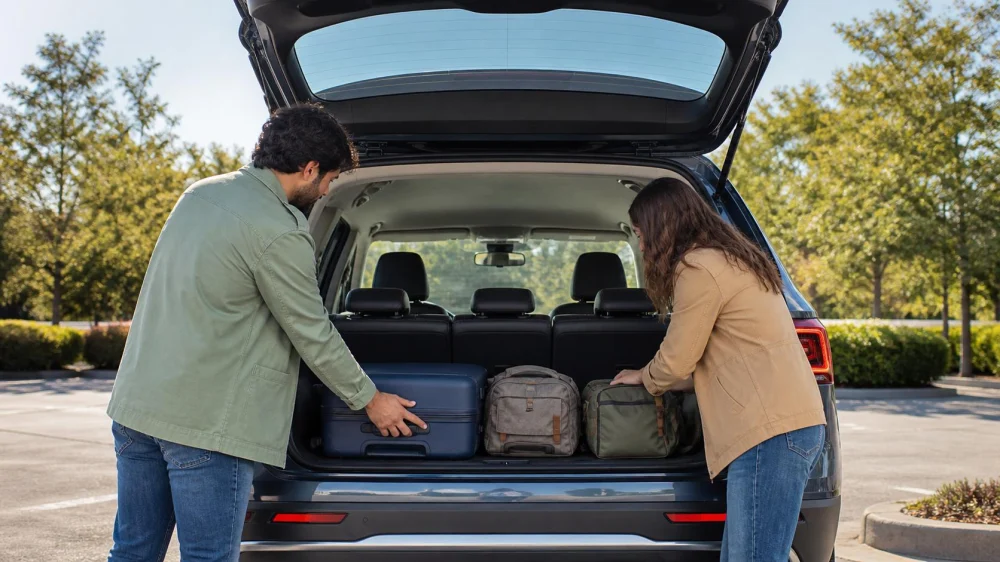
Rental Car Cargo Check: Secure Bags and Keep a Clear View
On this page
Quick answer
Before leaving the rental lot, confirm the vehicle’s passenger and cargo limits, fold-seat rules, tie-down points, cargo cover, and rental restrictions. Put dense bags low and forward in the cargo area, prevent every item from sliding or becoming a projectile, keep the rear and side views clear, and protect pedals, controls, airbags, seat belts, and exits. Close every latch, walk around, then recheck after the first stop.
This guide supports ordinary passenger-vehicle rentals in the United States. The owner’s manual, door labels, rental agreement, local law, road conditions, and provider instructions control the final load.
Check the vehicle and agreement
A safe rental-car cargo plan keeps the combined people and luggage within the vehicle’s limits while preserving stable placement, visibility, restraint systems, and access. Cargo volume alone does not show how much weight the vehicle can carry.
Locate the vehicle load information and owner’s manual. Account for every passenger, child restraint, mobility device, bag, cooler, accessory, and any equipment added during the trip. Do not exceed the stated occupant and cargo limits.
Review the rental agreement before folding or removing seats, attaching a rack, using a trailer, carrying sports equipment, or placing items on the roof. An accessory that fits physically may still be prohibited or incompatible with the vehicle.

Alamo Rent A Car
West ColumbiaLexington CountySouth Carolina
3000 Aviation Way, West Columbia, SC 29170, USA
Plan the load before packing
Choose luggage that fits the cargo opening and planned passenger layout. Measure oversized cases, strollers, wheelchairs, instruments, skis, golf bags, or coolers before selecting the vehicle class.
Separate items needed during the drive—documents, medication, water, child supplies, chargers, and weather gear—from items that should remain secured. Keep valuables out of sight when the vehicle is parked, but never hide an item where it interferes with driving equipment.
Use closed bags or containers so small objects do not escape. Avoid carrying loose glass, sharp tools, heavy metal items, or open liquids in the passenger compartment.
Load in a stable order
- Park safely. Use a level area away from traffic, set the parking brake, and keep children and pets supervised.
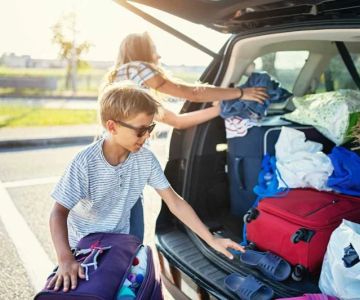
- Place heavy items first. Keep them low, stable, and within the intended cargo area.
- Fill gaps deliberately. Use soft bags to prevent movement without crushing fragile items or emergency equipment.
- Use approved anchors. Follow the manual for tie-down points, nets, partitions, and cargo covers.
- Protect seatbacks. Do not stack heavy luggage where it can surge over or through a folded seat during braking.
- Close and test. Confirm the hatch or trunk latches without force and no strap, fabric, or cord is trapped.
- Walk around. Check ride height, tires, doors, lights, mirrors, and anything visible beneath the vehicle.
Never ask a person to hold a heavy object as its restraint. Every occupant should use the seating position and belt system as designed.
Protect visibility and controls
From the adjusted driver’s seat, confirm useful views through the windshield, front side windows, mirrors, and rear area. Cameras and sensors can assist but do not make blocked glass or blind zones disappear.
Keep bags away from pedals, gear selection, parking brake, steering, dashboard, airbags, seat rails, belt buckles, door handles, and emergency exits. Do not place objects on the dashboard, rear shelf, or loose on a seat.
When the cargo area is full to the top of the seatbacks, use the vehicle’s approved barrier or restraint system if provided and permitted. If visibility or containment remains inadequate, use a larger vehicle or reduce the load.
Recheck during the trip
- Stop soon after departure in a safe place and check for shifting or new noise.
- Recheck after rough roads, hard braking, opening the hatch, or moving one bag.
- Keep emergency equipment accessible without unloading into traffic.
- Do not open a packed hatch on a slope if items may fall out.
- Inspect straps and approved anchors for loosening or abrasion.
- Remove food waste and liquids that could leak, smell, or stain the rental.
- Before return, check seat pockets, under seats, cargo wells, and accessory compartments for personal items.
Cargo checklist
- Passenger and cargo limits confirmed
- Rental restrictions on seats, racks, roof, towing, and equipment reviewed
- Oversized items measured before vehicle selection
- Heavy items low and stable
- Loose objects contained or restrained
- Seatbacks, belts, airbags, controls, and exits clear
- Driver views and mirrors unobstructed
- Trunk or hatch fully latched
- Load rechecked after the first safe stop
Limitations and safety notes
- Do not exceed the vehicle’s stated load limit or use cargo space as a passenger seat.
- Do not attach a rack, carrier, trailer, or roof load without provider permission and vehicle compatibility.
- Do not block required lighting, the license plate, exhaust clearance, doors, or safety equipment.
- Stop driving if the load shifts, a hatch warning appears, steering or braking changes, a tire looks overloaded, or visibility is unsafe.
- Ask the rental provider for a different vehicle when the reserved class cannot carry the people and equipment safely.
Frequently asked questions
Can I stack luggage above the rear seat?
Only when the vehicle’s approved restraint or barrier system contains it and visibility and load limits remain acceptable. Otherwise reduce or change the load.
Is the rear camera enough if luggage blocks the window?
No. Cameras have limited views and can be dirty, delayed, or unavailable. Preserve the visibility required for safe operation and applicable law.
Can I fold the rear seats?
Follow the manual and rental agreement. Confirm latches, belts, child-seat needs, cargo restraint, and passenger capacity before folding.
Can luggage go on the roof?
Only with provider permission, a compatible approved system, correct load limits, secure installation, and awareness of height and handling changes.
What if everything does not fit at pickup?
Do not force the hatch or place loose items around passengers. Ask for a larger suitable vehicle, reduce luggage, or arrange another approved transport method.
Sources and evidence notes
This article reflects general vehicle loading practice: follow the owner’s manual and load label, keep heavy cargo low and restrained, protect visibility and occupant systems, avoid unauthorized attachments, and recheck after movement. Exact limits and permitted equipment depend on the vehicle and rental agreement.
Next steps
Count passengers and list every large or heavy item before pickup. At the lot, read the vehicle load information, photograph the empty cargo area, and test the proposed layout without forcing doors or blocking views. If the load cannot be contained within the intended area, change the vehicle or transport plan before driving.


 National Car Rental3.0 (8 reviews)
 Hertz Car Rental - Atlanta - Lenox Road Ne2.0 (73 reviews)
 Mercedes Sprinter Van Rental4.0 (13 reviews)
 Hackett Lu Holdings, LLC - HLH Car Rental0.0 (0 reviews)
 NextCar4.0 (322 reviews)
 Oscar Car Rental Sun Prairie4.0 (10 reviews)
 Why SUVs Are the Most Popular Rental Choice in the U.S.
 Car Rental Requirements for Foreign Drivers in the US
 The Impact of Delivery & Pick-Up Services on Your Rental Car Price | LifeStar Car Rental
 How to Choose an EV Rental Car for U.S. Trips: Key Considerations for a Smooth Journey
 Best Rental Cars for Exploring the Florida Keys
 How to Choose Between Economy, Compact, and Mid-Size Car Rentals: Size and Fuel Insights