
Rental Car Spare Tire and Roadside Kit Check
On this page
Quick answer
Before leaving a U.S. rental location, find out whether the vehicle has a usable spare tire, a sealant-and-inflator kit, run-flat tires, or no customer-serviceable system. Locate the rental company’s roadside number, ask what flat-tire help costs and covers, and photograph the cargo area. Do not assume tools are present or that the contract permits you to change a tire.
Why this check matters
A rental car may look ready while its emergency equipment is missing, unfamiliar, or stored beneath luggage. Modern vehicles do not all use a full-size or temporary spare. Some have an inflator and sealant, some use run-flat tires, and some expect the driver to call roadside assistance.
A two-minute check at pickup makes the response to a flat more predictable. It also lets the rental location correct missing equipment before you accept the vehicle. This is an equipment and communication check, not a recommendation to perform roadside repairs in an unsafe place.

Identify the vehicle’s tire system
Ask the agent, “What is this vehicle designed to use after a flat?” Then verify the answer using the owner’s manual or the vehicle’s quick-reference guide. Look beneath the cargo floor, under the vehicle only from a normal standing viewpoint, or in a labeled side compartment. Do not crawl beneath a rental car.
- Full-size spare: a road wheel that may still have speed or rotation restrictions.
- Temporary spare: a smaller tire with printed speed and distance limits.
- Sealant and inflator: a powered compressor and sealant container with instructions and an expiration date.
- Run-flat system: tires designed for limited travel after pressure loss, subject to manufacturer limits.
- No onboard remedy: the rental company expects roadside service or towing.
Do not mix up an emergency mobility system with a permanent repair. A temporary spare, sealant kit, or run-flat tire is generally meant to reach appropriate service under specified limits.
Inspect the spare and tools
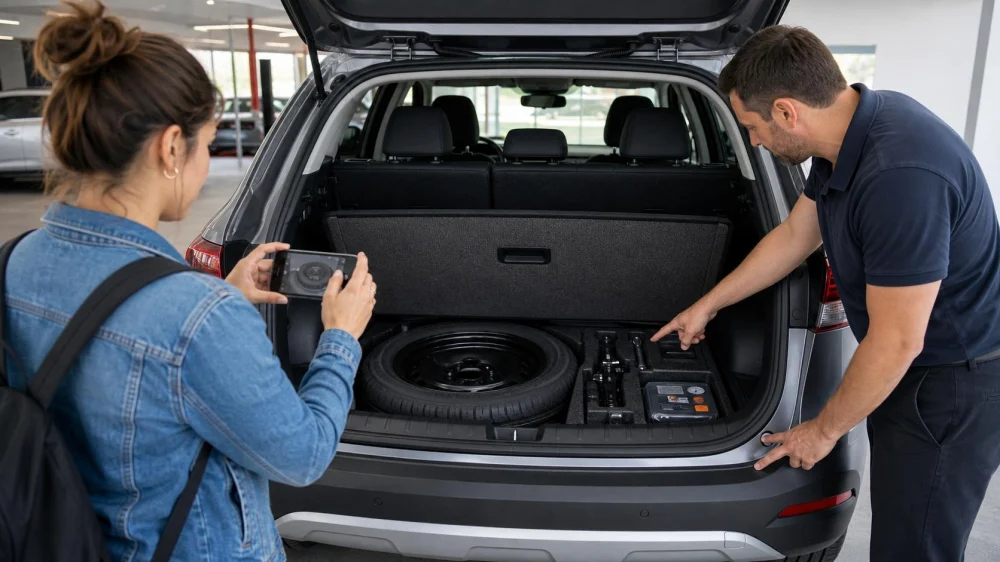
If a spare is provided, check that it is present, secured, and visibly free of obvious damage. You do not need to remove it. Ask staff to confirm its inflation if access or a gauge is unavailable. A flat spare cannot solve a flat road tire.
Check for the vehicle-specific jack, jack handle, and lug wrench. Some wheels require a locking-lug adapter; ask where it is. If the vehicle uses a sealant kit, confirm the compressor, power cord, hose, sealant canister, and printed instructions are present. Ask staff to replace an expired or leaking canister.
Photograph the opened storage area without moving equipment. The image records what was supplied and helps you repack it correctly. Do not test a sealant canister, deploy the jack, or loosen wheel hardware at pickup.
Confirm coverage and contact steps
Roadside assistance terms vary. The U.S. Federal Trade Commission advises renters to ask whether roadside assistance is included, whether it costs extra, and whether it covers events such as a flat tire, dead battery, or locked-in key. Check for possible duplicate benefits through an auto club, credit card, personal auto policy, or employer travel program, but verify current terms directly.
Save the rental company’s roadside number from the agreement or official app, not from an unverified search result. Ask which number to call first, whether outside towing needs prior authorization, what location information to provide, and who pays initially. Keep the rental agreement accessible offline.
Plan what to do after a flat
- Reduce speed smoothly and avoid abrupt braking or steering.
- Move to a safe, legal stopping place away from moving traffic if the vehicle can be moved safely.
- Turn on hazard lights and keep occupants away from traffic.
- Call emergency services if anyone is injured or the location creates immediate danger.
- Call the rental company’s authorized roadside line and follow its instructions.
- Photograph the tire and surroundings only from a safe position.
- Do not drive on a visibly flat tire unless the vehicle manufacturer and rental company specifically authorize limited run-flat travel.
Changing a tire beside fast traffic, on a narrow shoulder, on soft or sloped ground, or in poor visibility is not a reasonable DIY task. Request professional help. Even in a safe location, follow the rental agreement and vehicle instructions before touching the wheel.
Pickup checklist
- Ask which spare, inflator, run-flat, or roadside system the car uses.
- Confirm the spare or complete inflator kit is present.
- Locate the jack, wrench, and locking-lug adapter if applicable.
- Ask staff to address visible damage, missing pieces, or expired sealant.
- Save official roadside and rental-location phone numbers.
- Read costs, exclusions, authorization rules, and geographic limits.
- Photograph supplied equipment and record staff-confirmed issues.
- Store luggage so emergency equipment remains accessible.
Frequently asked questions
Must every rental car have a spare tire?
Do not assume so. Vehicle designs and rental fleets vary. Some vehicles use sealant kits or run-flat tires, and others rely on roadside service. Confirm the actual system at pickup.
Should I change the tire myself?
Only if the location is safe, the agreement permits it, the proper equipment is present, and you can follow the vehicle instructions. Calling authorized roadside assistance is the safer choice when any of those conditions is missing.
Will roadside assistance always be free?
No. It may be included, sold as an add-on, limited to certain events, or charged per incident. A tire damaged by driver action may be handled differently from ordinary mechanical failure. Read the specific agreement.
Can tire sealant repair any puncture?
No. Kits have manufacturer limits and may not work for sidewall damage, large punctures, wheel damage, or an empty or expired canister. Use only as instructed and notify the rental company.
Sources and limitations
The FTC rental car guide explains why renters should ask what roadside assistance includes and whether it costs extra. The National Highway Traffic Safety Administration road-trip guidance recommends checking for a spare and jack kit and carrying emergency supplies.
This article provides general U.S. travel planning, not legal, mechanical, insurance, or contract advice. Vehicle instructions, state roadside laws, rental agreements, and coverage terms control. Never sacrifice personal safety to inspect, photograph, or repair a tire.
Next steps
Add “spare or mobility kit” to your pickup inspection. Before loading bags, identify the system, confirm every component, save the authorized help number, and clarify coverage. If something is missing or unclear, ask for it to be documented, corrected, or handled with a different vehicle before driving away.




 Hertz Car Rental - Medford - Mystic Avenue2.0 (189 reviews)
 Medlife Ambulette0.0 (0 reviews)
 T&M Auto rentals5.0 (7 reviews)
 Budget3.0 (115 reviews)
 Luxe Car Rental0.0 (0 reviews)
 Alamo Rent A Car3.0 (219 reviews)
 Best Rental Cars for Driving in National Parks Like Yellowstone
 Rental Car Tire Check Guide: Inspect Before Driving
 Why Renting a Hybrid Car Can Save You More Than You Expect
 How to Avoid 'Refueling Fees' with Rental Car Fuel Policies
 How to Choose the Right Size Rental Car for Weekend vs Road-Trip Use
 Long-Term Car Rental in the US: Everything You Need to Know