
Rental Car Tire Check Guide: Inspect Before Leaving the Lot
Table of contents
Quick answer
Before leaving a rental lot, inspect all visible tire sidewalls and tread for cuts, bulges, cracking, objects, or obvious low pressure. Photograph each wheel, check the dashboard tire-pressure warning, find the manufacturer’s pressure placard, and confirm whether the vehicle has a spare, jack, sealant kit, or roadside plan. Report concerns immediately and request another vehicle rather than accepting an unsafe tire.

Dollar Car Rental - Pittsburgh International Airport
PittsburghAllegheny CountyPennsylvania
1000 Airport Blvd, Pittsburgh, PA 15231, USA
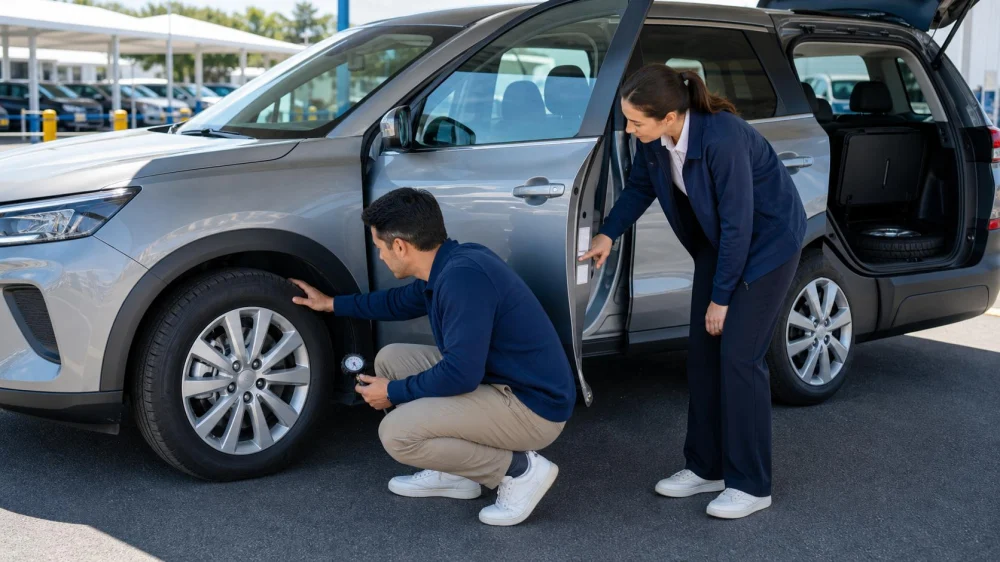
Perform a tire walkaround
Do the inspection in a well-lit area before loading luggage. Walk around the vehicle at a distance, then look closely without crawling under it or reaching into wheel wells.
- Compare whether one tire appears lower than the others.
- Look for sidewall bulges, deep cuts, exposed cords, severe cracks, or impact damage.
- Check visible tread for embedded objects and uneven wear.
- Inspect rims for major bends or fresh impact marks.
- Confirm valve-stem caps are present and stems are not visibly damaged.
- Photograph all four tires and any existing scuffs.
A visual check cannot measure pressure or reveal every internal defect, but it can identify reasons not to drive away.

Midtown Luxury Rentals
Deer ParkSuffolk CountyNew York
1067 Long Island Ave Suite 2, Deer Park, NY 11729, USA
Check pressure correctly
The correct pressure comes from the vehicle’s Tire and Loading Information label, usually on the driver-side doorjamb, or the owner information—not the maximum number molded on the tire sidewall. Front and rear recommendations can differ.
Cold pressure is measured before significant driving, generally after the vehicle has been parked for at least three hours. A tire-pressure monitoring warning can indicate significant underinflation, but no warning does not prove every tire is correct. Ask rental staff to measure and document pressure when anything looks wrong.
Locate flat-tire equipment
| System | What to confirm | Important limit |
|---|---|---|
| Full-size spare | Location, pressure, tools, instructions | May still be for emergency use |
| Temporary spare | Pressure and speed/distance label | Strict operating limits apply |
| Sealant and inflator | Kit present, sealed, not expired | Does not repair every puncture |
| Run-flat tires | Vehicle instructions and warning behavior | Distance and speed remain limited |
| Roadside only | Phone number, coverage, towing process | Wait location must be safe |
Do not assume every modern rental has a spare. Ask the agent to show you the actual equipment and the rental company’s required procedure.
Report a problem before departure
- Keep the vehicle parked and photograph the tire and dashboard.
- Notify the rental counter or documented support channel.
- Describe the exact tire position and visible issue.
- Request a measured inspection or replacement vehicle.
- Have the vehicle change and existing condition recorded.
- Reinspect the replacement before leaving.
Do not accept a verbal instruction to “see if the light goes away” when a tire looks damaged or significantly low. A warning may need simple pressure correction, sensor service, or tire repair; the rental company should resolve it before travel.
Respond safely on the road
If a warning appears, the car pulls, steering changes, vibration starts, or a tire loses air, slow smoothly and move to a safe location away from traffic if the vehicle remains controllable. Turn on hazard lights and follow local emergency guidance. Do not stop in an active lane unless the vehicle cannot move.
Call the rental company’s roadside channel before installing sealant, repairing, replacing, or towing unless immediate safety requires emergency action. The contract may specify authorized providers and documentation. Never change a tire in an unsafe roadside position.
Pickup checklist
- Inspect four visible tires and wheels.
- Photograph condition before departure.
- Check the tire-pressure warning at startup.
- Locate the doorjamb pressure placard.
- Confirm spare, jack, sealant, or run-flat system.
- Save roadside and rental support contacts.
- Ask about repair and towing authorization.
- Report concerns before loading or leaving.
- Repeat a quick check before a long route.
Safety and contract limits
Do not inflate a tire with visible structural damage, drive on a flat, crawl under a vehicle supported only by a jack, or use roadside equipment without safe conditions and correct instructions. Weather, traffic, terrain, physical ability, and vehicle design can make a tire change unsafe.
Rental coverage for tires, roadside calls, towing, and lost-use charges varies by company, contract, damage waiver, cause, and location. Read the agreement and get directions from the rental company; this guide cannot determine financial responsibility.
Evidence behind this guide
The National Highway Traffic Safety Administration advises checking tires for cuts, bulges, cracks, punctures, and pressure, including the spare; it says to use the vehicle manufacturer’s doorjamb or manual pressure, not the tire sidewall maximum. NHTSA also recommends confirming a spare and jack kit before travel. See NHTSA TireWise and NHTSA road-trip safety tips.
Frequently asked questions
Should the rental company check tire pressure?
Fleet procedures vary, but you should report any concern and request measurement or another vehicle before leaving.
Does no dashboard warning mean pressure is correct?
No. Monitoring systems typically warn after meaningful pressure loss and do not replace direct inspection.
Can I use the number on the tire sidewall?
No. That is not the vehicle’s recommended cold pressure. Use the doorjamb placard or manufacturer information.
What if there is no spare?
Confirm the inflator, sealant, run-flat system, or roadside process and its limits before departure.
Next steps
At pickup, photograph every tire, check the warning light, locate the pressure placard, and find the flat-tire system. Save roadside contacts and ask how authorization works. If any tire looks damaged or low, keep the vehicle parked and request documented inspection or replacement.



 Alamo Rent A Car3.0 (202 reviews)
 Royal Rent A Car of Great Neck5.0 (9 reviews)
 Hertz Car Rental - Windsor Locks - Bradley International Airport (BDL)3.0 (938 reviews)
 Cathay Express Transportation5.0 (1 reviews)
 Cathay Express Transportation4.0 (6 reviews)
 Enterprise Rent-A-Car4.0 (366 reviews)
 How to Get Cheap Car Rentals in Orlando International Airport
 Best Car Rental Options for Business Travelers in the US – Top Choices for Convenience and Comfort
 How to Avoid Paying for “Free” Upgrades That Actually Cost More in Hidden Fees
 How to Avoid Paying Twice for Rental Car Insurance with Credit Card Coverage
 Car Rental Cancellation Policies Explained: How to Avoid Penalties
 Unlimited Mileage vs Limited Mileage: Which Rental Car Option Is Better?