
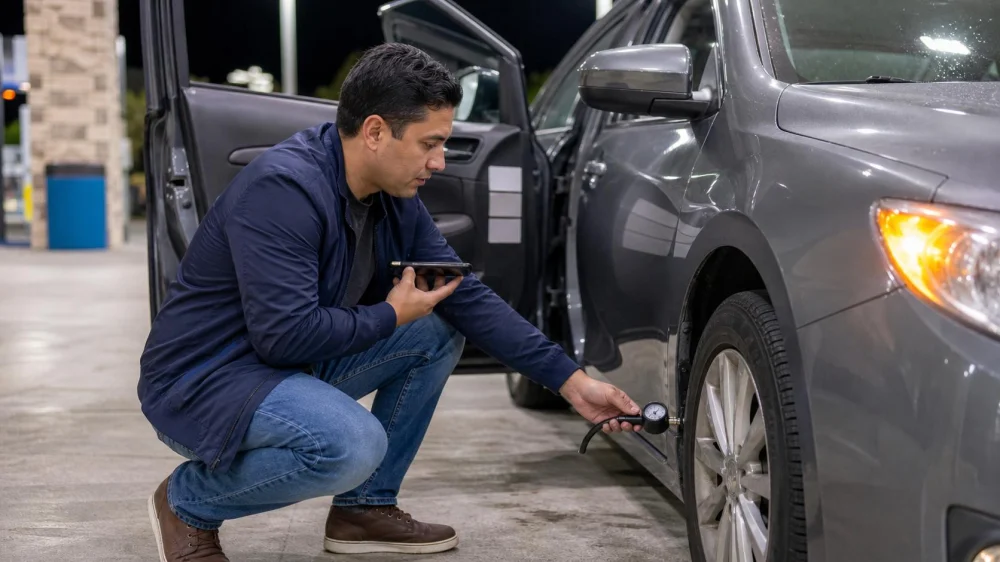
Rental Car Tire Pressure Light: Stop, Inspect, and Report
On this page
Quick answer
A steady tire-pressure warning means at least one tire is significantly underinflated. Reduce speed smoothly, avoid abrupt steering or braking, and stop in a safe location. Inspect for visible damage, check cold pressure against the driver-door placard or owner’s manual, and call the rental provider for instructions. A light that flashes before staying on can indicate a monitoring-system malfunction.
Enterprise Rent-A-Car
Thousand OaksVentura CountyCalifornia
3021 Thousand Oaks Blvd, Thousand Oaks, CA 91362, USA
Move to a safe location
Keep both hands on the wheel and assess how the car feels. Pull over promptly when the warning is accompanied by vibration, thumping, pulling, visible smoke, loss of control, or a rapid pressure message. Do not continue to the next exit if the tyre appears flat or damaged. Use hazard lights and roadside emergency practices appropriate to the location.
Choose a level area away from moving traffic. Do not stand beside a traffic-facing wheel on a narrow shoulder. Stay in the protected vehicle and call emergency or roadside services when exiting would be unsafe. A warning light alone does not tell you which tyre or how quickly pressure changed.
Enterprise Rent-A-Car
MercerMercer CountyPennsylvania
1891 Leesburg Grove City Rd, Mercer, PA 16137, USA
Inspect without guessing
Walk around only when safe and look for a visibly low tyre, nail, cut, bulge, split, damaged wheel, or foreign object. Do not touch hot rubber or remove an embedded object. Compare all four tyres and the spare if the provider directs. Underinflation can be difficult to judge by sight.
Check whether the dashboard identifies a specific wheel, but remember that a display can lag or show a sensor fault. Note the time, location, weather, recent pothole or curb impact, and handling change. Photograph the warning and tyre from a safe position without exposing unrelated personal or rental data.
Use the correct pressure
The correct cold inflation pressure is on the vehicle’s Tire and Loading Information label at the driver-side door edge or pillar, or in the owner’s manual. Do not use the maximum pressure moulded into the tyre sidewall as the target. Front and rear recommendations can differ.
“Cold” generally means the vehicle has been parked long enough for tyres to cool. Driving raises pressure and can mask marginal underinflation. If the rental provider authorizes checking or adding air, use an accurate gauge and follow its instructions. Do not overinflate to make the light disappear or reset a warning without correcting the cause.
Contact the rental provider
Call the roadside number in the rental agreement or app before arranging an outside repair. Give the agreement number, vehicle location, warning behaviour, tyre condition, gauge readings if safely obtained, and whether the car is drivable. Ask whether to wait for service, exchange the car, use an approved facility, or take another step.
Do not plug, seal, patch, replace, or change a wheel unless the provider authorizes it and you are trained, equipped, and in a safe location. Some vehicles lack a spare or use special mobility equipment. Unauthorized work may affect reimbursement, liability, or vehicle systems.
Understand a flashing light
NHTSA explains that a warning flashing for roughly 60 to 90 seconds and then remaining illuminated can indicate a TPMS malfunction. The system may not reliably detect low pressure. Treat the monitoring system as unavailable: inspect and check tyre pressure, then contact the rental company for vehicle-specific instructions.
A light that appears on a cold morning and later turns off can still indicate marginally low pressure as temperature changes. Do not dismiss it. Check the tyres as soon as possible and report recurrence. Temperature explains pressure movement but does not prove there is no leak.
Document service and return
Save call times, representative names, case numbers, readings, photographs, service receipts, and the approved action. If the car is exchanged, record fuel, mileage, belongings, damage condition, and the replacement agreement. Ask how towing, transport, lodging, or missed-time costs are handled before incurring them when possible.
At return, obtain a receipt and written note that the tyre warning was reported. Do not rely only on a verbal handoff at a busy lot. Remove personal data from the car and keep records until final charges and any claim are resolved.
Frequently asked questions
Can I keep driving with a steady TPMS light?
Inspect and check pressure as soon as possible. Do not continue on a visibly low or damaged tyre or when handling changes. The rental provider should direct the next step.
Why did the light turn on after the temperature dropped?
Cold air can reduce tyre pressure enough to cross the warning threshold. The tyres still need checking against the vehicle placard; warmer driving pressure does not repair a leak.
Should I inflate to the number on the tyre sidewall?
No. Use the vehicle manufacturer’s placard or owner’s manual. The sidewall number is not the recommended operating target for that rental car.
Sources and limitations
The U.S. National Highway Traffic Safety Administration’s TireWise safety guidance explains the TPMS warning, cold-pressure checks, driver-door placard, visual limits, temperature effects, and flashing malfunction sequence. This article cannot assess a tyre remotely. Vehicle manuals, roadside conditions, rental agreements, and provider instructions control a specific incident.
Conclusion and next steps
Treat the warning as actionable: slow smoothly, stop safely, inspect, and use the vehicle placard for pressure. Contact the rental provider before repair and avoid driving on visible damage or changed handling. Preserve the warning, readings, instructions, and final receipt in one record.



 Go Rentals5.0 (2 reviews)
 Enterprise Rent-A-Car4.0 (237 reviews)
 Enterprise Rent-A-Car4.0 (100 reviews)
 SIXT Rent a Car Chicago South Loop4.0 (701 reviews)
 Hertz Car Rental - Glendale - West Glendale Avenue2.0 (284 reviews)
 Uber Car Rentals by Hertz2.0 (170 reviews)
 How to Use Membership Clubs & Hidden Promo Codes for Lower Rental Car Rates
 Best Car Rental Options for Business Travelers in the US – Top Choices for Convenience and Comfort
 What Happens When You Return a Rental Car Late: Fees & Tips
 What Happens When You Get Into a Minor Accident With a Rental Car
 Understanding Car Rental Policies for Holiday Weekend Price Surges
 Best Rental Car Options for Uber and Lyft Drivers