
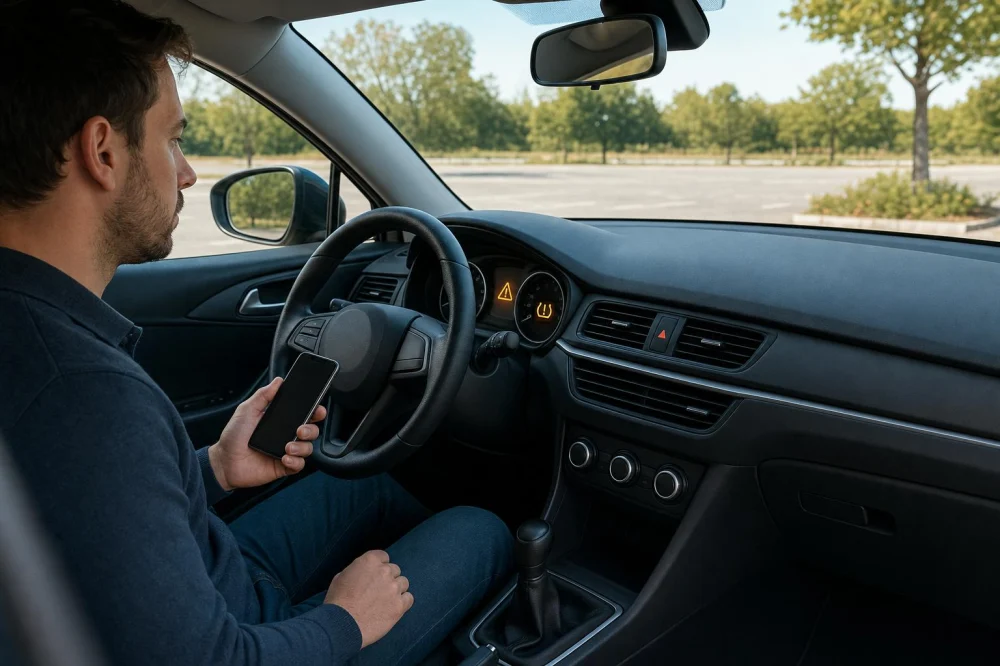
Rental Car Warning Lights: What to Do Before Driving On
In this guide
A warning light in an unfamiliar rental car can mean something minor, such as low washer fluid, or something urgent, such as overheating, low oil pressure, a brake-system problem, or dangerous tire pressure. Symbols, colors, and messages differ by vehicle. Do not guess from memory or keep driving merely to avoid a schedule change.
Hertz Car Rental - Greensboro - Westover Terrace
GreensboroGuilford CountyNorth Carolina
1619 Westover Terrace, Greensboro, NC 27408, USA
Quick answer
Reduce speed smoothly, observe how the car feels, and move to a safe legal place away from traffic if the warning may be serious or the vehicle behaves abnormally. Photograph the full instrument panel and exact message while parked. Consult the owner's manual, then call the rental company's roadside number on the agreement or key tag. Stop the engine for an overheating or oil-pressure warning and do not drive a car with braking, steering, smoke, fuel smell, severe vibration, or tire-control problems.
Put people and traffic safety first
Keep control of the car. Avoid sudden braking or sharp steering unless necessary to prevent a collision. Turn on hazard flashers when appropriate, signal, and take the nearest safe exit or pull-off. A parking lot or rest area is usually safer than a narrow shoulder.
If the vehicle loses power, steering, braking, or stability, move out of travel lanes if you can do so safely and call emergency services when there is immediate danger. Stay behind a barrier or in another protected location rather than standing next to fast traffic. Follow local instructions from police or road operators.
At night or in severe weather, visibility and personal security also matter. Tell roadside assistance your exact location, direction of travel, nearby marker, passenger needs, and whether the car is blocking traffic.
Record exactly what the vehicle shows
Once safely parked, photograph the entire cluster, close-up symbol, written message, fuel level, odometer, and any visible external problem. Note the time, location, speed, road conditions, sounds, smells, vibration, loss of power, and what happened immediately before the warning.
Do not erase messages or disconnect the battery. Avoid repeatedly restarting the engine just to see whether a light disappears. Diagnostic information can help the rental company and technician understand the fault.
If the message vanishes, record that too. An intermittent warning can still matter, especially when combined with heat, poor running, fluid under the car, or a recent impact.
Color helps, but the symbol and behavior matter
Red commonly signals a condition needing immediate attention, while amber or yellow often means caution or service soon. Green, blue, and white usually indicate a system status. These are useful patterns, not universal rules. The same symbol may flash, stay solid, or appear with a message that changes its urgency.
Use the vehicle's owner's manual or built-in guide for the exact model. A manual may be in the glove box or available through the manufacturer's official site. Search by year, make, and model only while parked.
Vehicle behavior overrides color. Smoke, steam, burning odor, fuel smell, grinding, loss of braking or steering, severe shaking, or a rapidly deflating tire requires prompt stopping even if no red symbol is visible.
Warnings that often require stopping
An oil-pressure warning can mean the engine is not receiving adequate lubrication. Stop in a safe place and switch off the engine. Driving farther can cause major damage. A red temperature or overheating warning also calls for stopping and shutting down safely; never open a hot radiator or coolant cap because pressurized fluid can cause severe burns.
A brake-system warning combined with a soft pedal, grinding, poor stopping, fluid leak, or abnormal vehicle behavior is an emergency. Do not continue. A battery/charging warning may mean the car can soon lose electrical power; move to safety and call before it stalls in traffic.
Steering warnings, transmission-temperature warnings, a flashing check-engine light, and multiple simultaneous alerts also deserve urgent guidance. The exact manual and rental provider determine the next step.
Respond to a tire-pressure warning
A tire-pressure monitoring light can indicate underinflation, overinflation, temperature-related pressure change, a puncture, or a monitoring-system fault. Slow down, avoid hard maneuvers, and inspect from a safe location. Do not drive on a visibly flat, damaged, bulging, smoking, or rapidly losing tire.
Compare pressures with the vehicle's specified cold-tire values, usually on the driver's door-jamb label—not the maximum printed on the tire sidewall. Rental agreements may require calling roadside service rather than using sealant, changing a tire, or authorizing repair.
Some tire lights remain on briefly after correct inflation or require a reset procedure. Do not reset a warning merely to silence it without checking the tires. Record any pressure reading and follow the rental company's direction.
Handle a check-engine light cautiously
A steady check-engine light covers many possible faults. If the car runs normally and the manual does not instruct an immediate stop, park safely and call the rental provider for guidance before a long drive. Check that the fuel cap is properly secured only if it is safe and the vehicle uses a conventional cap.
A flashing check-engine light often indicates a more serious misfire that can damage the catalytic converter. Reduce load, stop safely, switch off the car, and request assistance. Do not continue to the destination hoping it will clear.
Do not buy a code reader, clear fault codes, or pay a shop without authorization. A code is a starting clue, not a complete diagnosis, and unauthorized work may complicate reimbursement or responsibility.
Contact the rental company before repairs
Use the roadside or emergency number on the rental agreement, app, key tag, or official company website. Explain the exact symbol and message, vehicle behavior, location, and passenger situation. Ask whether to switch off the engine, wait for roadside service, drive a short distance, or arrange a tow.
Record the representative's name or case number, call time, and instructions. Ask who will authorize and pay for towing, tire service, diagnosis, replacement transportation, parking, or lodging. Follow up in writing when possible.
Do not rely solely on advice from a third-party booking site if the rental company owns or controls the vehicle. The rental provider's contract and roadside process usually govern authorization.
Towing, roadside service, or replacement
The company may send roadside assistance, direct you to a nearby branch, tow the vehicle, or arrange a replacement. Confirm whether you should remain with the car, where the keys go, what belongings to remove, and how transportation to the branch will be handled.
Before a tow, photograph all sides of the car, wheels, fuel level, mileage, cabin, and where it was left. Remove passports, medication, electronics, child seats, toll devices, and luggage if safe. Get the tow operator's name, destination, and receipt or dispatch record.
At replacement, inspect the new vehicle and ensure the rental agreement is updated. Confirm fuel policy, return location, toll arrangement, driver list, rate, and whether time lost or charges will be adjusted.
Protect the trip with good documentation
Keep photos, videos, call logs, case numbers, chat transcripts, receipts, towing documents, repair estimates, and both old and revised agreements. Write a short timeline while details are fresh. Documentation does not guarantee reimbursement, but it makes a later review far clearer.
Save proof that you followed instructions. If a representative tells you to drive, ask for the instruction in the case notes or by message. If conditions change—new noise, higher temperature, stronger smell, or worse handling—stop and call again.
At return, request a written closure or incident record. Review the final bill and dispute unexplained charges promptly through the company's documented process.
Frequently asked questions
Can I drive if an amber warning light is steady?
Not automatically. Park safely, read the exact manual entry, assess vehicle behavior, and contact the rental company. Amber can still signal a condition that should not continue through a long trip.
Should I add oil or coolant myself?
Do not open a hot cooling system or perform work without guidance. Call the rental company. It may require roadside service, and using the wrong fluid can cause damage.
Who pays for towing?
Responsibility depends on the agreement, roadside package, cause, and authorization. Confirm before ordering a tow when circumstances permit and keep all records.
What if the warning disappears after restarting?
Report it with the photo and symptoms. Intermittent problems can return, and restarting does not prove the vehicle is safe.
Can I exchange the vehicle at any branch?
Availability and authority vary. Call first, obtain a case number, and confirm the exact location and process before driving there.
When uncertain, stop and ask
A rental car is unfamiliar equipment governed by an agreement, so guessing is a poor trade. Move to safety, document the exact alert, use the model-specific manual, and contact the rental provider before driving farther or authorizing work. Immediate symptoms—loss of control, smoke, heat, oil pressure, braking trouble, severe tire damage, or a flashing engine light—deserve a stop, not an optimistic detour.




 Jasmyne Enterprises, LLC5.0 (3 reviews)
 Budget Car Rental3.0 (163 reviews)
 Thrifty Car Rental - E Sahara Thrifty1.0 (1 reviews)
 Budget Car Rental3.0 (74 reviews)
 Exotic Car Collection by Enterprise1.0 (1 reviews)
 Hertz Car Rental - Lee's Summit - East Langsford Road2.0 (261 reviews)
 Best Rental Cars for Family Reunions and Group Travel
 Best Rental Cars for Long Road Trips Across the United States
 The Ultimate Guide to Renting a Car for First-Time Automatic Drivers
 How to Get Cheap Car Rentals in San Diego Airport
 Why SUVs Are the Most Popular Rental Choice in the U.S.
 Best Rental Cars for Exploring the South Dakota Badlands