
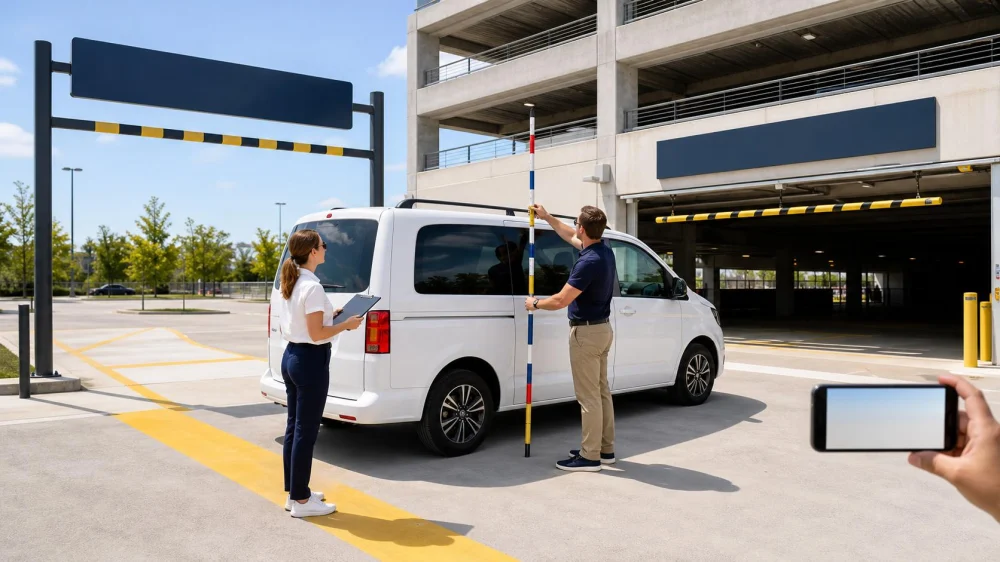
Rental Car Garage Height and Roof Clearance: A Driver Checklist
On this page
- Quick answer
- Know the vehicle’s true height
- Inspect roof-mounted equipment
- Read garage restrictions before entry
- Plan the route inside
- Account for ramps and transitions
- Watch for changing overhead obstacles
- Manage cargo and temporary equipment
- Choose an alternative before getting stuck
- What to do if clearance is uncertain
- What to do after an overhead strike
- Document and report roof damage
- Clearance checklist
- Frequently asked questions
- Next steps
Quick answer
Before entering a parking garage, drive-through, car wash, ferry deck, covered loading area, or low bridge, know the rental vehicle’s height as configured today. Include roof rails, antenna, cargo box, bike rack, ladder rack, mobility equipment, and any temporary load.
Compare that measurement with posted clearance, but leave a safety margin for slope changes, hanging signs, pipes, sprinklers, speed bumps, uneven pavement, and inaccurate assumptions. If the vehicle height is unknown or close to the limit, stop in a safe legal location before entry and choose surface parking or another route. Never rely on following a similar-looking vehicle, guessing from vehicle class, or asking a passenger to stand in traffic as a spotter.

Lux Hub Exotic Car Rentals Atlanta
1700 Northside Dr NW, Atlanta, GA 30318, USA
Know the vehicle’s true height
Rental reservations guarantee a category more often than an exact model. A compact SUV, full-size SUV, passenger van, cargo van, pickup, and box truck can differ significantly in height.
Find the height in the vehicle manual, door-area label when provided, manufacturer specifications for the exact model and configuration, or rental-company fleet information. Roof rails, tires, suspension, conversion equipment, and accessories can change it.
Do not confuse overall vehicle height with ground clearance, cargo-area height, or garage-clearance recommendation. Use consistent units.
For a moving truck or van, ask the rental company whether a height decal is posted in the cab. Verify whether it includes air-conditioning units, roof fairings, racks, or other equipment.
Inspect roof-mounted equipment
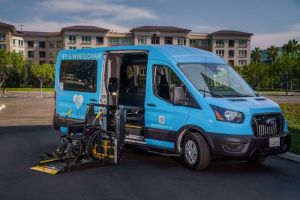
Walk around the vehicle at pickup. Look up from several angles without climbing. Identify antenna, rails, crossbars, cargo carrier, roof tent, bike mount, ladder rack, refrigeration unit, beacon, satellite equipment, or mobility hardware.
Photograph the roof as well as the sides when practical and safe. Roof damage can be difficult to see from ground-level return photos.
Ask whether accessories are removable, folded, fixed, or prohibited from alteration. Do not remove an antenna, rack, or fleet device without permission.
A flexible antenna can still strike a structure and damage its base or roof. Do not assume it will simply bend safely.
Read garage restrictions before entry
Look for maximum height, weight, length, width, fuel, trailer, roof-rack, and vehicle-type restrictions before committing to the entrance lane.
Posted clearance usually reflects the facility’s controlling point, but construction, temporary signs, snow, pipes, and maintenance equipment can reduce space.
Some garages have different clearances by level. An entrance may be high enough while an upper ramp, older section, or exit is lower.
Do not enter a lane where reversing is prohibited or impossible until you are confident. Know the alternate route in advance.
Plan the route inside
Choose designated oversized-vehicle or van parking when available. Follow signs and staff instructions.
Stay centered in the travel lane while maintaining side clearance. Avoid cutting close to columns, hanging equipment, or parked vehicles.
Identify the exit route before parking. A vehicle that fits the entrance may not fit a different exit lane or spiral ramp.
Do not park under low pipes, sprinkler heads, cable trays, signs, or door mechanisms even if the driving lane clears them.
Account for ramps and transitions
Vehicle pitch changes on steep ramps. The front of a long van can rise toward an overhead surface while the wheels remain on different slopes.
Speed bumps, drainage channels, and ramp crests alter body position. Clearance is not simply a flat vertical measurement.
Long wheelbase and rear overhang can also create ground-clearance or tail-swing problems. Watch both high and low hazards.
Slow, smooth movement improves observation but does not create more physical clearance. Stop before the controlling point if uncertain.
Watch for changing overhead obstacles
Clearance bars at the entrance provide warning but are not measuring tools. Striking a bar means stop, not continue because the vehicle “almost fits.”
Construction netting, temporary lights, signs, pipes, ventilation ducts, sprinklers, roll-up doors, tree branches, snow, and hanging cables can appear below the main structure.
Open tailgates, hatches, raised roofs, and pop-up equipment can hit ceilings while parked. Close everything before moving.
Roof equipment can also affect automated car washes. Follow the rental agreement and wash operator restrictions; some rental vehicles should not use automatic washes.
Manage cargo and temporary equipment
Roof cargo changes height and may shift. Use only rental-company-approved racks and loading methods within all weight and securement limits.
Measure after loading, not before. Record the total on a temporary reminder inside the cab without blocking sight lines or damaging the vehicle.
Bicycles, kayaks, skis, boards, luggage boxes, ladders, and mobility devices can extend above or beyond the roof. Account for mounts and straps.
Remove temporary equipment before entering a low structure only in a safe legal area and according to the rental and equipment instructions. Never unload in an entrance lane.
Choose an alternative before getting stuck
Search for surface parking, oversized-vehicle areas, hotel loading zones, transit connections, or a different garage before arrival.
Call the destination and give the exact vehicle type and measured height. Ask for the clearance at entrance, internal route, parking space, and exit.
Passenger and cargo vans may need commercial or oversize spaces. Airport return garages sometimes have a designated route for tall vehicles.
Budget extra walking or transfer time. Convenience is not worth roof, rack, sprinkler, or structural damage.
What to do if clearance is uncertain
Stop before the entrance in a safe legal place where you do not block traffic. Turn on hazard lights only as appropriate and follow facility instructions.
Contact the garage attendant, destination, or rental company. State the measured total height, vehicle type, and current position.
Do not have a passenger stand on the roof, hang from the side, walk into active traffic, or hold a measuring pole near wires and structures.
If you entered a lane but cannot proceed, wait for trained facility staff to control traffic and direct a safe exit. Do not reverse blindly.
What to do after an overhead strike
Stop safely without causing a second collision. Do not continue beneath the structure if something is caught, leaking, hanging, or unstable.
Check occupants and call emergency services for injury, fire, fuel leak, electrical hazard, damaged sprinkler system, structural damage, or blocked traffic.
Do not climb on the vehicle or touch hanging wires, pipes, glass, signs, or broken roof equipment. Follow facility staff and emergency directions.
Notify the rental company promptly. Do not attempt a hidden repair, remove damaged fleet equipment, or leave without reporting facility damage.
Document and report roof damage
From a safe ground location, photograph the vehicle, roof edge, accessories, damage, facility sign, posted clearance, lane, and surrounding conditions. Do not expose other people or private information unnecessarily.
Record time, location, direction of travel, weather, cargo configuration, and whom you contacted. Obtain an incident number from the facility and rental company when provided.
Review the rental agreement and insurance or card coverage notification requirements. Roof and overhead damage can have specific exclusions or procedures.
Do not drive a vehicle with compromised roof structure, broken glass, damaged antenna, leaking equipment, or loose cargo until the rental company confirms the safe next step.
Clearance checklist
- Confirm exact model and configured vehicle height.
- Include rails, antenna, racks, cargo, and mobility equipment.
- Photograph the roof at pickup.
- Read entrance, internal, and exit restrictions.
- Allow margin for ramps, bumps, pipes, signs, and construction.
- Close hatch, tailgate, and pop-up equipment before moving.
- Measure again after adding roof cargo.
- Choose surface parking when clearance is close or unknown.
- Ask staff for traffic control instead of reversing blindly.
- Stop, report, and document any overhead strike.
Frequently asked questions
Can I trust the height listed for the vehicle online?
Use exact model and configuration information, then account for rental accessories, tires, racks, cargo, and modifications. Generic class dimensions may differ.
How much extra clearance do I need?
There is no universal margin. Facility conditions, slope changes, measurement accuracy, and temporary obstacles matter. If close, choose another option.
Does a flexible antenna count in vehicle height?
Yes. It can strike, break, or damage its base. Include every roof component unless the rental company confirms an approved configuration.
What if the entrance bar touches the vehicle?
Stop before proceeding. Contact facility staff and exit under direction. The bar is a warning that available clearance may be insufficient.
Will rental coverage pay for roof damage?
Coverage, exclusions, deductibles, and reporting vary by rental agreement, insurer, and card benefit. Review terms and report promptly.
Next steps
At pickup, identify every roof component, confirm total height, and photograph the roof. Check destination parking before departure. If any clearance is uncertain, use surface parking or contact staff before entering. Stop and report immediately after any contact.
This guide provides general driving and planning information. Vehicle dimensions, facility clearances, rental terms, traffic law, and coverage vary.





 Hertz Car Rental - Somerville - Somerville Avenue2.0 (235 reviews)
 Avis Car Rental - Foster City3.0 (97 reviews)
 Keywise Auto Sales3.0 (39 reviews)
 K&X Car Rental Service Inc. 柯信租车罗兰岗店3.0 (20 reviews)
 Car Rental Atlanta Hartfield Airport4.0 (102 reviews)
 DashForce LLC0.0 (0 reviews)
 Best Rental Cars for National Park Road Trips in America
 How to Avoid Unauthorized Rental Car Charges
 Best Rental Cars for Exploring the Florida Keys
 What You Should Know Before Adding an Extra Driver to Your Rental Contract
 How to Find a Small Fuel-Efficient Rental Car for Business Travel in the U.S.
 Best Rental Cars for Scenic Drives in Utah National Parks