
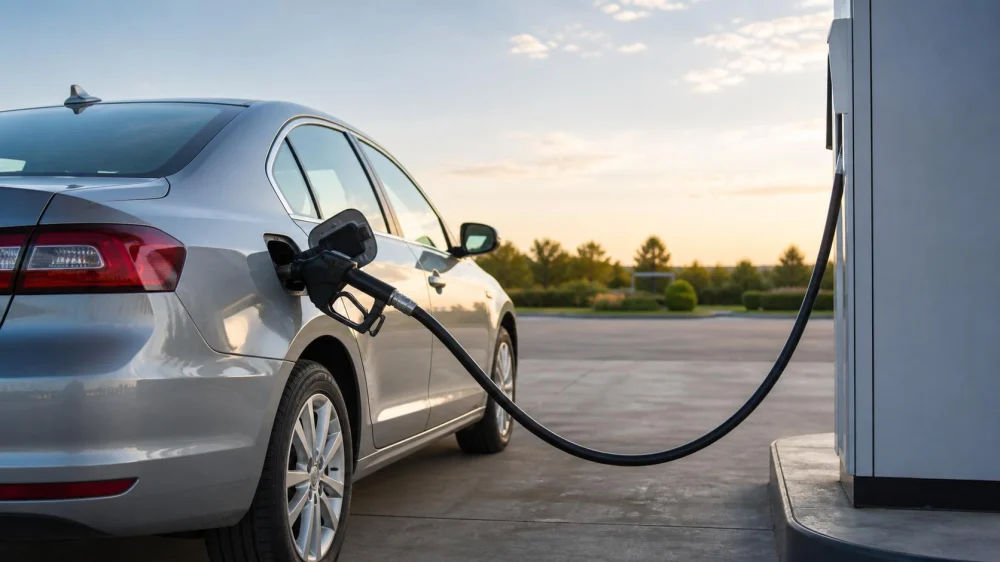
Rental Car Fuel Options: Prepay, Refill, or Pay the Provider
On this page
Quick answer
Most U.S. rental fuel arrangements fall into three practical patterns: return the vehicle at the required level after buying fuel yourself, buy a prepaid fuel option at pickup, or return it below the required level and pay the provider's refueling charge. The cheapest choice depends on the written rate, starting level, tank size, expected driving, local pump prices, and how much fuel remains at return.
Before leaving the lot, read the fuel clause on the rental agreement, photograph the dashboard fuel gauge, confirm the correct fuel type, and ask what proof of refueling is required. Do not assume “prepay” means you pay only for the fuel used.

Record the starting fuel level
The return obligation may be full-to-full, same-to-same, or another level printed on the agreement. Compare the written level with the dashboard while the vehicle is parked safely on reasonably level ground. If they differ, ask the rental location to correct the record before you drive away.
- Photograph the gauge and odometer together if practical.
- Save the pickup agreement and inspection record.
- Identify whether the vehicle takes gasoline, diesel, or another fuel.
- Ask how the provider measures a partial tank.
- Confirm whether a nearby-station receipt is required at return.
Option 1: refill it yourself
Buying fuel at a local station is often economical when you can plan a stop and return the vehicle at the specified level. The Federal Trade Commission notes that rental-company fuel prices are usually higher than local station prices when a renter returns below the requirement.
Factor in the detour, station access, traffic, operating hours, and return deadline. Refuel close enough to the return location to satisfy any receipt or distance rule in the contract. Keep the receipt and take a parked dashboard photo after refueling.

Hertz Car Rental - Worcester - Park Avenue
WorcesterWorcester CountyMassachusetts
561 Park Ave, Worcester, MA 01603, USA
Option 2: prepay for fuel
A prepaid option can reduce return-day pressure because you may not need to refill, but the calculation varies. Some plans charge for a tank or a stated quantity at pickup, and unused fuel may not be refunded. A competitive per-gallon rate can still produce a high effective cost if you return with substantial fuel remaining.
Ask for the total prepaid amount, not only the advertised unit price. Confirm whether taxes or fees apply, what happens to unused fuel, and whether the choice can be changed after pickup. Estimate how much of the tank your itinerary will actually use.
Option 3: let the provider refill
If you decline prepay and return below the required level, the provider may charge a stated per-gallon, per-mile, or service rate. This can be convenient when a delay makes refueling impractical, but it may cost more than a local station. Use the rate and calculation printed in your agreement, not an old web page or another location's policy.
Some companies offer special low-mileage fuel arrangements at participating locations. Ask whether the option applies automatically, what mileage limit controls it, and whether a refueling receipt avoids the charge.
Compare the real trip cost
Use a simple estimate rather than comparing labels alone. For self-refill, consider expected gallons used multiplied by a realistic local pump price plus the time and distance of the stop. For prepay, use the entire amount you must pay minus any stated refund. For provider refill, estimate the shortage using the contract's stated rate and measurement method.
Leave room for uncertainty. Vehicle class may change, fuel economy varies with traffic and weather, and the gauge is not a precise gallon counter. Convenience may reasonably outweigh a small price difference on a tight schedule.
Build a return-day fuel plan
- Check the return deadline and route before departure.
- Locate more than one suitable station near the return site.
- Allow time for traffic, payment problems, and a closed pump.
- Use only the fuel type specified by the vehicle and provider.
- Keep the final fuel receipt.
- Park safely and photograph the gauge, odometer, and vehicle condition.
- Ask for a closed rental receipt when available and review it promptly.
If the fuel charge looks wrong
Compare the final receipt with the pickup fuel record, return photos, fuel receipt, mileage, and contract rate. Contact the rental company's customer service with a concise timeline and copies of the evidence. Keep originals and note case numbers.
If the company does not resolve a U.S. consumer complaint, the FTC advises contacting the rental company, reporting suspected fraud at ReportFraud.gov, and contacting the state attorney general as appropriate. A card dispute has deadlines and evidence requirements; review the issuer's process rather than using it as the first or only contact.
Pickup checklist
- Fuel level on agreement matches the gauge.
- Correct fuel type is known.
- Return fuel requirement is clear.
- Prepaid total and unused-fuel rule are understood.
- Provider refueling rate and calculation are written down.
- Receipt or distance rules are confirmed.
- Pickup photos and agreement are saved.
Important limitations
This is general U.S. rental-planning information, not legal, tax, or financial advice. Fuel options, rates, taxes, vehicle systems, measurement methods, and contract terms vary by company, location, vehicle, and reservation. The signed rental agreement and the provider's current written disclosure control your transaction.
Evidence notes
Current FTC consumer guidance recommends comparing total rental cost and warns that provider refueling commonly costs more than buying fuel locally; it also notes that prepaid fuel can be convenient but more expensive. Current Enterprise and Avis materials show that providers offer multiple fuel choices with company- and location-specific calculations. Those sources support verifying the exact contract rather than assuming a universal rule.
FAQ
Is prepaid fuel always cheaper per gallon?
No. Compare the total charge and the likely unused fuel, not just the unit price.
Do I need to return a prepaid-fuel car empty?
Do not drive unnecessarily to empty it. Confirm the plan's terms and return safely.
How close to the return location should I refuel?
Follow the contract's receipt or distance rule; when none is clear, ask the location.
What if the pickup fuel level is wrong?
Photograph it and ask the location to correct the rental record before departure.
Can I estimate gallons from the dashboard bars?
Only roughly. Gauge segments are not precise gallon measurements.
Should I keep the fuel receipt?
Yes. It can show location, time, quantity, and payment when a charge is questioned.
Next steps
At pickup, compare the three written fuel choices using your route and expected mileage. Record the starting gauge and fuel type, save the agreement, and set a return-day reminder with a nearby station and enough time to refuel.






 LA OC CAR RENTAL4.0 (146 reviews)
 Thrifty Car Rental - Greensboro International Airport-(GSO)2.0 (74 reviews)
 Dimmples Car Rentals3.0 (11 reviews)
 Enterprise Rent-A-Car4.0 (528 reviews)
 Drivo Rent A Car4.0 (3536 reviews)
 Hertz Car Rental Tustin3.0 (119 reviews)
 Family Road Trip Rental Cars: Essential Features and Common Pitfalls
 Best Scenic U.S. Drives to Experience With a Rental Convertible | LifeStar Car Rental
 How to Get a Rental Car When You Have Irregular Hours or Need 24-Hour Pickup
 Tips for Using Your Rental Car on Scenic American Road Trips
 Why SUVs Are the Most Popular Rental Choice in the U.S.
 7 Reasons to Book a Rental Car Instead of Using Ride-Share Apps