
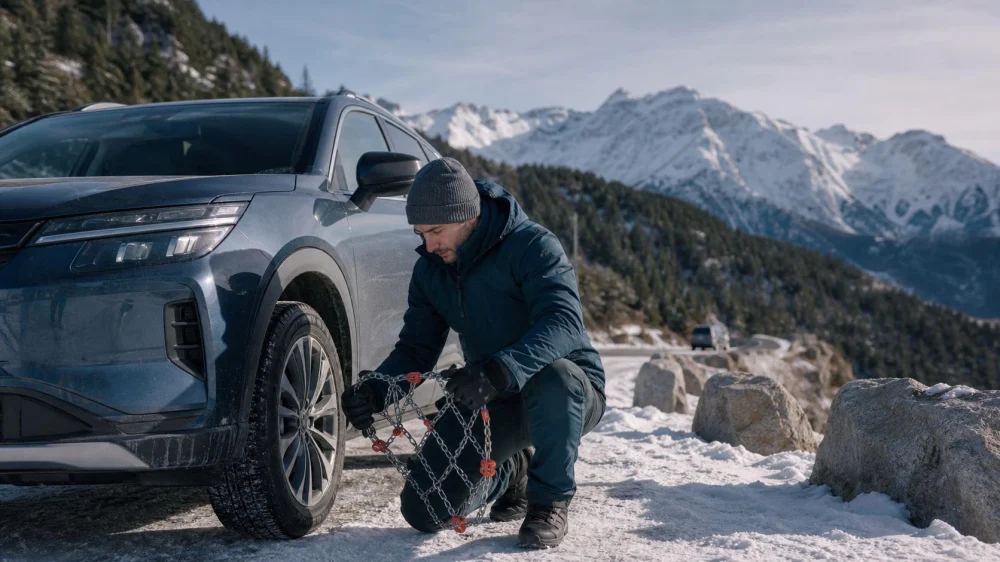
Rental Car Snow Chains: Check Rules Before the Mountain
On this page
- Quick answer
- Check three separate sets of rules
- Identify the exact rental vehicle
- Get the correct traction device
- Practice before reaching snow
- Monitor road and chain controls
- Install only in a safe location
- Drive within device and road limits
- Respond to noise, damage, or closure
- Document removal and rental return
- Pre-trip checklist
- Official safety sources
- Conclusion and next steps
Quick answer
Before taking a rental car into snow, check the rental agreement, the vehicle owner's manual, and road authority rules. Confirm whether the rental company permits chains or cables, which approved device fits the exact tire size, and which axle the manufacturer specifies. Carry the device when required even if the car has all-wheel drive, and practice installing it in dry daylight. Never enter a posted chain-control area unprepared; reroute or wait if the vehicle, contract, or device cannot comply safely.
This guide uses California examples because mountain chain controls are common there. Requirements vary by state, road, weather, vehicle, and posted instruction.
Check three separate sets of rules
The rental contract may prohibit or limit traction-device use or charge for resulting damage. Ask the rental location for the policy in writing before leaving.
The vehicle manufacturer determines clearance, approved device type, placement, and speed limits. Some vehicles cannot accept conventional link chains but may allow low-clearance cables or another device.
The road authority controls whether a vehicle may enter. Posted signs and officer instructions take priority over an old forecast, blog, or assumption about all-wheel drive.
Identify the exact rental vehicle
A reservation class such as “midsize SUV” is not enough. Device fit depends on the vehicle delivered, tire size printed on the sidewall, drive system, wheel clearance, and manufacturer's instructions.
At pickup, record the year, make, model, tire size, and whether it is front-wheel, rear-wheel, all-wheel, or four-wheel drive. Verify that all four tires are the correct size and inspect tread and pressure.
Locate the owner's manual in the glovebox or the manufacturer's official digital manual. Do not guess the drive axle from the vehicle's appearance.
Get the correct traction device
Confirm that the exact tire size appears on the traction-device packaging and that the device type is permitted by the vehicle manufacturer and rental contract.
Caltrans uses “chains” as a broad term for qualifying tire traction devices unless link chains are specifically named. Cables and other approved low-clearance systems may fit some vehicles that cannot accept conventional chains.
Carry the complete set, tensioners if required, instructions, waterproof gloves, kneeling mat, reflective outerwear, flashlight, and a waterproof storage bag. Do not rely on finding the correct size at the control point.
Practice before reaching snow
With permission and in a safe dry location, open the package, count the parts, and practice the manufacturer's installation sequence. Check for twists, broken links, damaged cables, or missing fasteners.
Learn which face and fastener point outward, how the inner connection closes, and whether retensioning is required after a short distance. Repack the device so the first needed part is accessible.
If the rental car changes, repeat the fit check. A device for the initially expected model may not fit the car actually assigned.
Monitor road and chain controls
Check the official state transportation map, weather service, road closures, and destination alerts before departure and again before climbing into mountain conditions.
California commonly describes R-1, R-2, and R-3 restrictions. Exemptions narrow as conditions worsen, and even qualifying four-wheel-drive vehicles may need to carry devices.
Conditions can change after departure. Keep fuel, charge, warm clothing, water, food, and medication sufficient for delays, and identify a lower-elevation alternate route.
Install only in a safe location
Follow chain-control signs and official directions. Pull completely off the traveled roadway into a designated or clearly safe area before installation.
Set the parking brake, activate hazard lights where appropriate, wear visible clothing, and keep passengers away from traffic. Follow the vehicle and device manuals exactly.
Caltrans notes that independent chain installers may operate for a fee and are not Caltrans employees. Confirm the price and obtain identifying information or a receipt before accepting help.
Drive within device and road limits
Obey the lowest applicable speed: posted limit, traction-device limit, manufacturer limit, or the speed conditions safely allow. Accelerate, brake, and steer gradually.
Leave extra following distance and avoid wheel spin, sudden lane changes, cruise control, and dry pavement when the device instructions prohibit it.
All-wheel drive can improve acceleration but does not eliminate limited braking or cornering grip on ice. Do not treat an exemption as proof that conditions are safe for your skill level.
Respond to noise, damage, or closure
If a chain or cable strikes the vehicle, loosens, or breaks, slow smoothly and stop at the first safe area. Continuing can damage tires, brakes, steering, bodywork, or wheel-well components.
Do not crawl under an inadequately secured vehicle or stop in a live lane to repair a device. Call roadside assistance or emergency services when the location is unsafe.
If the road closes or the vehicle cannot legally continue, turn around only where directed and safe. Contact the rental company before abandoning, towing, or arranging a substitute vehicle.
Document removal and rental return
Remove devices only after passing the official end-of-control sign and reaching a safe pull-off area. Do not drive farther on bare pavement than the product allows.
Inspect tires, wheels, wheel wells, brake lines, and body panels for visible changes. Photograph any concern and notify the rental company promptly under the agreement.
Dry and pack personal devices before the return inspection. Save receipts, roadside records, road-closure notices, and rental communications if a charge or claim may follow.
Pre-trip checklist
- Rental company's written traction-device policy
- Exact vehicle, drive system, tire size, and owner's manual
- Approved device type, placement, clearance, and speed limit
- Complete device set with instructions and required tensioners
- Dry-location practice installation
- Official road, weather, closure, and chain-control checks
- Gloves, mat, light, visible clothing, and waterproof storage
- Alternate route and supplies for delays
- Roadside assistance and rental-company contact details
Official safety sources
Caltrans explains device definitions, drive-axle placement, all-wheel-drive treatment, and restriction levels on its chain requirements page.
Its chain-control guidance tells drivers to check current conditions, follow vehicle specifications, and use a safe pull-off area for removal.
NHTSA's winter driving tips cover vehicle preparation, emergency supplies, tires, and safe behavior in snow, sleet, and ice.
Conclusion and next steps
A rental car does not remove the driver's responsibility to follow winter controls. Resolve the contract, vehicle, and road rules before climbing toward snow, carry a correctly fitted device, and practice in safe conditions. Monitor official updates and choose delay or rerouting when compliance is uncertain. Preparation protects the vehicle, the rental agreement, and everyone sharing the road.


 Thrifty3.0 (16 reviews)
 RDU Medical Transport Group LLC4.0 (39 reviews)
 Avis Car Rental2.0 (78 reviews)
 A Running Start Auto LLC5.0 (6 reviews)
 Avis Car Rental2.0 (300 reviews)
 Avis Car Rental3.0 (214 reviews)
 Understanding Car Rental Policies for Holiday Weekend Price Surges
 Can You Rent a Car Across State Lines? What to Know About Interstate Rules
 How to Avoid Misleading ‘Unlimited Mileage’ Labels in Rental Agreements
 How to Avoid Paying for Insurance You Already Have When Renting a Car
 A Complete Guide to Renting a Car for a Father’s Day Weekend Fishing Trip With Gear
 Is a One-Way Car Rental Really More Expensive? How to Find the Best One-Way Deal